 Contact
 About us
 Magazine
High tech with growth
Photonics in Graubünden
We tend to take an end-to-end approach, place much greater emphasis on applications and focus less on components than other photonics locations.
Christian Eric Thöny Chairman of the Board, CEDES AG
Light as a key technology
Photonics connects technology with applications
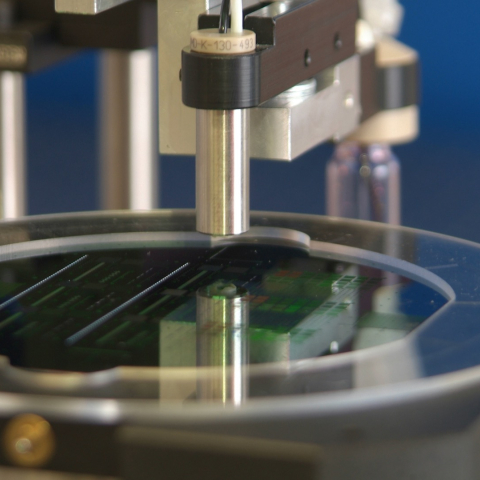
Photonics encompasses technologies that generate, transmit, control, measure or detect light. These underpin optical sensors, lasers, image processing, measurement technology and many other applications, from life sciences and medical technology to industrial automation, robotics and autonomous systems.
Its particular strength lies in its role as an enabling technology across sectors. Photonics connects different stages of the value chain, from materials and optical components to integrated products and systems, industrial applications and services. This creates a distinctive opportunity for Graubünden: photonics is consistently approached from the perspective of applications and industrialisation.
Good ideas need neighbours
A cluster spanning the value chain
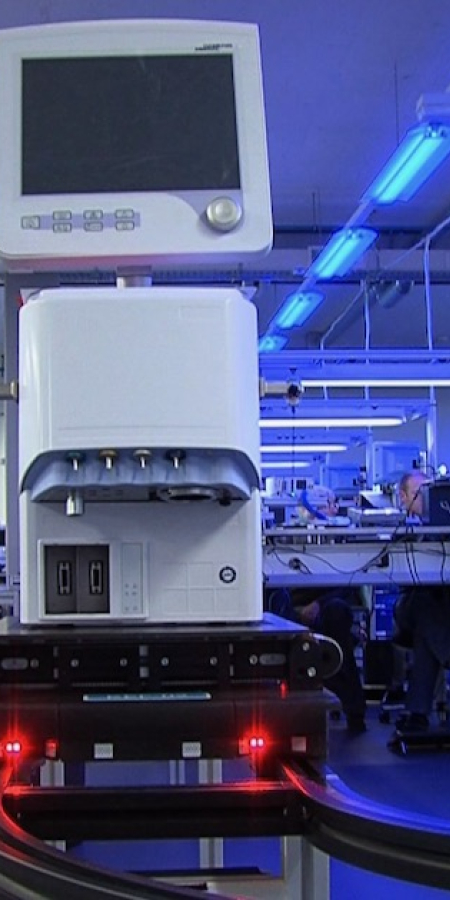
Successful technology clusters emerge where specialised companies, suppliers, industrialisation partners, users and researchers work together in close geographical proximity. Graubünden’s Rhine Valley already has a broad industrial base to support this. With CEDES Graubünden is home to an internationally active manufacturer of optoelectronic sensor solutions. Specialised partners include Profatec in precision manufacturing, GRITEC in development, automation and industrialisation and, Variosystems, Polycontact and WITTENSTEIN with expertise in electronics, sensor technology and mechatronics. On the application and systems side, internationally active companies such as Hamilton, INTEGRA Biosciences and TRUMPF complement the industrial environment.
This technology ecosystem extends beyond the cantonal border along the Alpine Rhine. It includes ESPROS Photonics in Sargans, with expertise in semiconductor and time-of-flight sensor technology, Evatec in Trübbach, with production technologies for thin films and photonics, SwissOptic and Leica Geosystems in Heerbrugg, with expertise in precision optics and industrial measurement technology. In Liechtenstein, Materion Balzers Optics and INFICON add capabilities in precision optics, coating and measurement technologies. Hilti and Ivoclar further broaden the ecosystem as internationally active technology companies and industrial users.
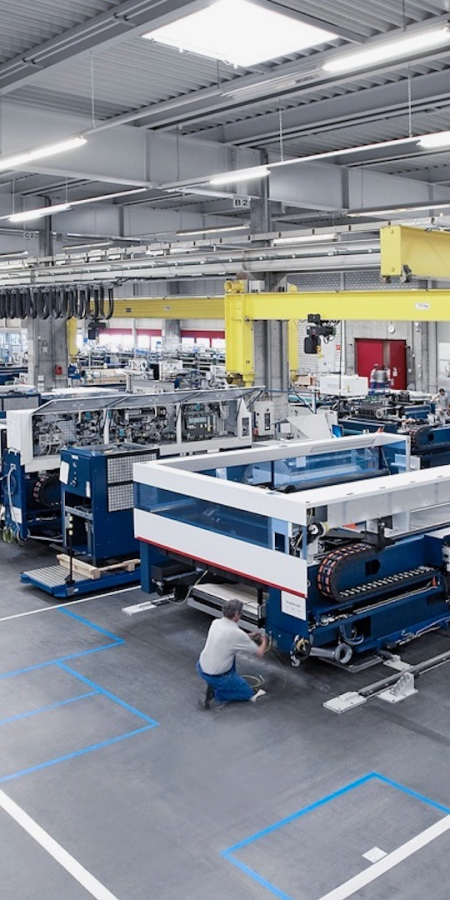
The particular strength of this ecosystem lies in its end-to-end approach. Within a compact area, expertise in semiconductor and sensor technology, precision optics and coatings comes together with electronics, automation and industrialisation, as well as practical applications in life sciences, medical technology, automation and industrial measurement. Photonics companies considering establishing operations here gain access to potential suppliers, development and production partners and industrial users, alongside an environment where new technologies can be developed, brought into industrial production and scaled.

Overview of the location advantages in Graubünden:
| Industrialisation | Entwicklung, TeDevelopment, testing and production can take place in close geographical proximity.st und Produktion können räumlich eng miteinander verbunden werden. |
|---|---|
| Research and technology transfer | Application-oriented research institutions help address development questions and transfer new technologies into marketable products. |
| Skilled workforce | Through its Optoelectronics (Photonics) study specialisation, FH Graubünden trains engineers specifically for light-based technologies. |
| Growth | Serviced industrial sites offer opportunities for additional development space, laboratories and production capacity. |
| Funding and support | Depending on the project, funding and support schemes for research, development, innovation and business growth can be explored. |
| Close connections | Companies gain access to relevant institutions, partners and the cantonal administration. |
From research to application
Turning knowledge into products
For high-tech companies, the volume of research carried out in a location is only part of the picture. What matters is how quickly relevant knowledge reaches industrial applications.
FH Graubünden and CSEM in Landquart provide businesses with two partners focused on practical applications. FH Graubünden closely connects education and applied research with regional industry. Its Optoelectronics (Photonics) study specialisation and its photonics and optoelectronics laboratory provide access to both specialist talent and technical infrastructure.
CSEM complements this environment as a technology innovation centre, providing access to expertise and research networks that individual companies do not have to build entirely themselves. Businesses can draw on external expertise to address specific development questions and then incorporate it into their own products and processes.
For companies establishing a new location in particular, this environment helps bridge the gap between research, development and industrial implementation.
