 Contact
 About us
 Magazine
In Graubünden
Available resources for companies
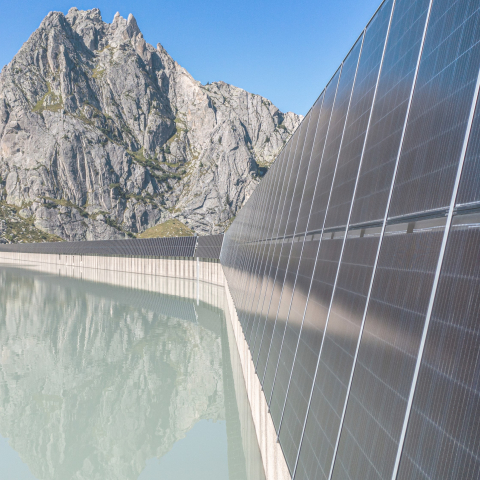
The canton of Graubünden is supplied with energy safely and economically using locally produced renewable energy.
Graubünden Cantonal Energy Structure Plan
Energy from our own resources
Hydropower as the backbone of industry
Graubünden is one of Switzerland’s most important hydropower regions, producing more than 8'000 GWh of electricity each year, compared with cantonal demand of around 2'000 GWh. More than 50 reservoirs, storage power plants and run-of-river power plants provide a stable, flexible energy supply and make an important contribution to grid stability. Hydropower is increasingly complemented by photovoltaics, biomass, wind energy and ambient heat.
Companies with annual consumption of more than 100 MWh can choose their electricity supplier freely and tailor procurement to their consumption profile. Actual costs depend on the location, grid level, load profile, network tariffs, levies, and any connection and expansion costs. There is therefore no single industrial electricity price for Graubünden; sample tariffs are for guidance only and do not replace an individual quotation.
Rate Examples 2026
The following figures are provided solely for guidance and should be understood as rough benchmarks. They are not directly comparable and do not replace a quotation tailored to the location and consumption profile. All figures exclude VAT.
The standard energy price shown does not necessarily apply to open-market customers: they purchase energy from a supplier of their choice, while the regulated network charges and levies at the location continue to apply.
| IBC Chur, electricity grid G, annual consumption over 50 MWh | Standard energy rate: 11.90 Rp./kWh; grid usage charge: 9.50 Rp./kWh; system services charge: 0.73 Rp./kWh; federal levy: 2.30 Rp./kWh; concession levy: 2.00 Rp./kWh; additional demand charges and metering costs apply. |
|---|---|
| IBC Chur, connection at grid level 5 | Standard energy rate: 11.90 Rp./kWh; grid usage charge: 5.90 Rp./kWh; system services charge: 0.73 Rp./kWh; federal and concession levies; additional demand charges and metering costs apply. |
| Repower, connection at grid level 5 | Standard energy rate: 9.60 Rp./kWh; grid usage charge: 3.60 Rp./kWh; combined charge for system services, electricity reserves and shared costs: 0.73 Rp./kWh; federal levy: 2.30 Rp./kWh; municipal levy varies by municipality; additional standing, demand and metering charges apply. |
| Repower, connection at grid level 3 | Standard energy rate: 9.60 Rp./kWh; grid usage charge: 2.00 Rp./kWh; combined charge for system services, electricity reserves and shared costs: 0.73 Rp./kWh; federal levy: 2.30 Rp./kWh; municipal levy varies by municipality; additional standing, demand and metering charges apply. |

High-performance digital infrastructure
Ultra-high-speed broadband, fibre optics and 5G
Depending on the location, fibre-optic, coaxial and other broadband connections are available in Graubünden. The canton specifically supports the expansion of ultra-high-speed broadband outside the major centres as well. The aim is to provide symmetrical connections of more than 100 Mbit/s.
Mobile networks are also being continuously expanded. At the end of 2025, Swisscom and Sunrise each reported 5G coverage of at least 99 per cent of the Swiss population. Salt reported technology-neutral population coverage of 99.9 per cent. Because population coverage is not the same as comprehensive geographical coverage, reception, capacity and redundancy should be assessed separately for each industrial site.
Energy for high temperatures
Gas for selected industrial processes
In Graubünden, gas is available primarily along the main economic and settlement corridor in the Graubünden Rhine Valley as far as Thusis. In the medium and long term, the cantonal structure plan envisages gas primarily where it is technically difficult to replace: for high-temperature process heat in industry and commerce and, in selected cases, to cover peak loads in district heating networks.
In addition to natural gas, products with different proportions of biogas are available. Whether a plot can be connected and what connection capacity is available must be assessed for each location.
As a guide, the 2026 IBC industrial tariff lists an energy price of 4.70 ct./kWh for companies consuming more than five million kWh. Additional charges apply for grid usage, demand, the standing charge, the CO₂ levy, the concession levy and the levy to ensure winter supply.
Use local energy sources
Heating, cooling and anergy networks
Heating and anergy networks are available to companies in Chur, Domat/Ems and Maienfeld. They use local energy sources such as groundwater, industrial waste heat and energy from waste recovery, enabling an efficient supply of heat and, in some cases, cooling.
These solutions are particularly suitable for production companies, laboratories, data centres and mixed-use sites. Availability, connection capacity and costs are assessed for each location.

Connected to resource markets
Raw materials and components by road and rail
Via the A13, companies in Graubünden are directly connected to procurement and sales markets in Switzerland and Europe. The central north–south corridor provides access to German-speaking Switzerland, Ticino and Northern Italy. Numerous industrial and commercial areas in the Graubünden Rhine Valley are located close to motorway junctions and therefore benefit from short transport routes.
The Landquart transshipment hub plays a central role in rail freight transport. There, containers, conventional freight, petroleum products, roundwood, and heavy and bulky shipments can be transferred between road transport, the Swiss standard-gauge rail network, and the Rhaetian Railway. The Rhaetian Railway network then transports the freight to more than 30 service points in various regions of Graubünden.

Regional raw materials for diverse value creation
Natural resources
Graubünden has significant natural resources. Nevertheless, water supply, raw material availability and usable land must always be assessed for each location and project.
Water for a Variety of Needs
As an Alpine canton, Graubünden is part of the “Water Castle of Europe” and boasts a wide variety of water resources. Municipal supply networks provide drinking and industrial water. When there is a significant need for process or cooling water, we work with municipalities and utilities to assess the available volume, network capacity, and water quality. Withdrawals from groundwater or surface water, as well as the discharge of industrial wastewater, may be subject to permits or concessions.
Valuable Raw Materials from the Region
Graubünden offers access to regional resources such as gravel, sand, natural stone, wood, and agricultural products. About 30 percent of the canton is forested; the timber stock amounts to approximately 54 million m³. In addition, there are over 2'000 farms – including about 1'240 organic farms – with a total cultivated area of more than 56'000 ha. This foundation opens up opportunities for the construction, timber, energy, and food industries, as well as for regional value chains.
Room for Business Growth
With an area of 7'105 km², Graubünden is Switzerland’s largest canton and offers ample space for long-term business development. Since only about two percent of the canton’s total area is used for urban development, available sites are concentrated in specifically developed locations. A total of over 300'000 m² of industrial space is available to businesses. We’ll help you find the right site with the necessary energy, water, digital, and transportation connections.
Finding the right mix of resources
Every industrial site has its own supply profile
Available resources vary by region and industrial site. We help businesses clarify key location requirements early on, from electricity connections, energy costs and heating, cooling and gas supplies to fibre broadband, 5G, road access, rail connections and freight handling facilities. Together with network operators, municipalities and other partners, we provide clarity on availability, investment needs, delivery timescales and ongoing operating costs.
